

Sell More at 35,000 Feet: English That Pays
Aviation English
Aviation English for In-Flight Retail: How Cabin Crew Can Sell More in English
In 2026, airlines are running high-altitude retail operations where every interaction is a revenue opportunity — and English is the skill that turns service into sales.
Estimated reading time: 8 minutes
Key Takeaways
- Ancillary revenue will exceed $130 billion by 2026, with onboard sales a major slice.
- Most cabin crew are trained in hospitality English, not sales English — and it’s costing airlines millions.
- Aviation English for in-flight retail combines product vocabulary, persuasive phrasing, and objection handling.
- NILDS builds revenue-ready cabin crew through role-play, pitch labs, and clarity coaching.
- English is no longer a basic requirement — it is a revenue skill that pays for itself on the first flight.
Table of Contents
In 2026, airlines are no longer just flying people from A to B. They are running high-altitude retail operations where every interaction is a revenue opportunity. From duty-free trolleys to onboard meal upgrades and credit card promotions, cabin crew are now front-line salespeople. But here is the catch: most crew members are not trained to sell in English. They can serve, they can smile, they can handle safety—but when it comes to recommending a premium whiskey, upgrading a passenger to a better seat, or explaining a loyalty program, many freeze. That is where aviation English for in-flight retail becomes a game-changer.
Why In-Flight Retail Is a Goldmine (And Why English Matters)
Ancillary revenue now accounts for a significant share of airline profits. According to industry estimates, global ancillary revenue will exceed $130 billion by 2026. Onboard sales—duty-free, food and beverage upgrades, comfort items, and travel accessories—are a major slice of that pie. But here is the problem: on international routes, passengers speak dozens of languages. English remains the common denominator. When a crew member can confidently say, “This fragrance is our best-seller, and today it comes with a complimentary travel pouch,” the likelihood of a sale skyrockets.
Airlines that invest in in-flight sales English training see measurable results: higher conversion rates, larger average transaction values, and improved customer satisfaction. Why? Because selling in English is not about pushy tactics. It is about clarity, warmth, and the ability to match a product to a passenger’s need—all in a second language.
The Hidden Barrier: Crews Know Service, Not Sales English
Most cabin crew are trained in hospitality English for cabin crew: greetings, safety instructions, meal service, and handling complaints. That is essential. But upselling requires a different vocabulary. You need phrases for product recommendation, handling objections, creating urgency, and closing a sale. Without dedicated cabin crew upselling English, crew members often default to passive service: “Would you like to buy something?” instead of “I highly recommend this for your flight—it is our most popular item today.”
This gap is costing airlines millions. A crew that cannot confidently explain a product’s value in English will not sell it. A crew that cannot handle a simple question like “Is this compatible with my phone?” will lose the sale. And a crew that sounds unsure or scripted will not build the trust needed for onboard retail communication English to work.
The real problem is not the product or the price — it is that crew members have never been taught how to sell in English.
What Is Aviation English for In-Flight Retail?
Aviation English for in-flight retail is a specialized branch of English training that combines general aviation English with sales and hospitality communication. It focuses on:
Product vocabulary. Describing fragrances, electronics, accessories, and duty-free exclusives with confidence.
Persuasive phrasing. “This is perfect for”, “You will love how”, “Many passengers choose this because”.
Handling questions. Answering about prices, currencies, warranties, and compatibility clearly and quickly.
Upselling and cross-selling. “Would you like to add a second one at a discount?” or “This pairs beautifully with the item you just selected.”
Cultural sensitivity. Adjusting tone for different passenger nationalities while keeping English as the base.
At NILDS, our aviation English training 2026 programs are built specifically for airline ancillary revenue teams. We do not teach generic business English. We teach the exact phrases, scenarios, and confidence builders that turn a service interaction into a sale.
Duty-Free Selling Phrases That Actually Work
Let us get practical. Here are five English phrases that cabin crew can use immediately to boost onboard sales:
The Warm Open. “While you are relaxing, may I show you something special we have on board today?”
The Benefit Hook. “This moisturizer is perfect for long-haul flights—it keeps your skin hydrated at 35,000 feet.”
The Social Proof. “This is our best-selling perfume this month. Would you like to try a sample?”
The Gentle Close. “Shall I wrap this up for you, or would you like to see one more option?”
The Upsell. “If you take two, you get a free travel case—many passengers do this for gifts.”
These are not manipulative tricks. They are clear, polite, and effective. But they require practice. Crew members need to say them until they feel natural, not memorized. That is why spoken English for cabin crew upselling must be interactive, scenario-based, and repetitive in a safe training environment.
How NILDS Builds Revenue-Ready Cabin Crew
NILDS specializes in aviation English training for airlines that want to turn language skills into profit. Our programs include:
Role-play simulations. Real in-flight scenarios with passengers from different cultures.
Product pitch labs. Crew members practice describing actual duty-free items in English.
Objection handling drills. “That is too expensive” or “I will think about it”—and how to respond.
Accent and clarity coaching. So every passenger understands the first time.
Ancillary revenue communication skills. Linking sales to service, not pressure.
We have worked with airlines across Asia, the Middle East, and Europe. The common thread? Crews who feel confident in English sell more, smile more, and create a better passenger experience. That is the definition of a win-win.
The 2026 Advantage: English as a Revenue Skill
By 2026, competition in the skies will be fiercer than ever. Low-cost carriers are expanding, premium airlines are differentiating through service, and every route is a battle for ancillary revenue. Airlines that treat English as a basic requirement will fall behind. Airlines that treat English as a revenue skill—specifically, in-flight sales English training—will lead.
Your crew does not need to become fluent salespeople. They need to become confident English communicators who can recommend, explain, and close. That is a learnable skill. And it pays for itself on the very first flight.
Final Thought: Speak Better, Sell More, Fly Further
If you are an airline training manager, a cabin crew recruiter, or a crew member who wants to earn more through onboard sales, the message is simple: invest in English for airline ancillary revenue teams. It is not an expense. It is a revenue accelerator.
At NILDS, we help aviation teams unlock that potential. Because when your crew speaks better, they sell better. And when they sell better
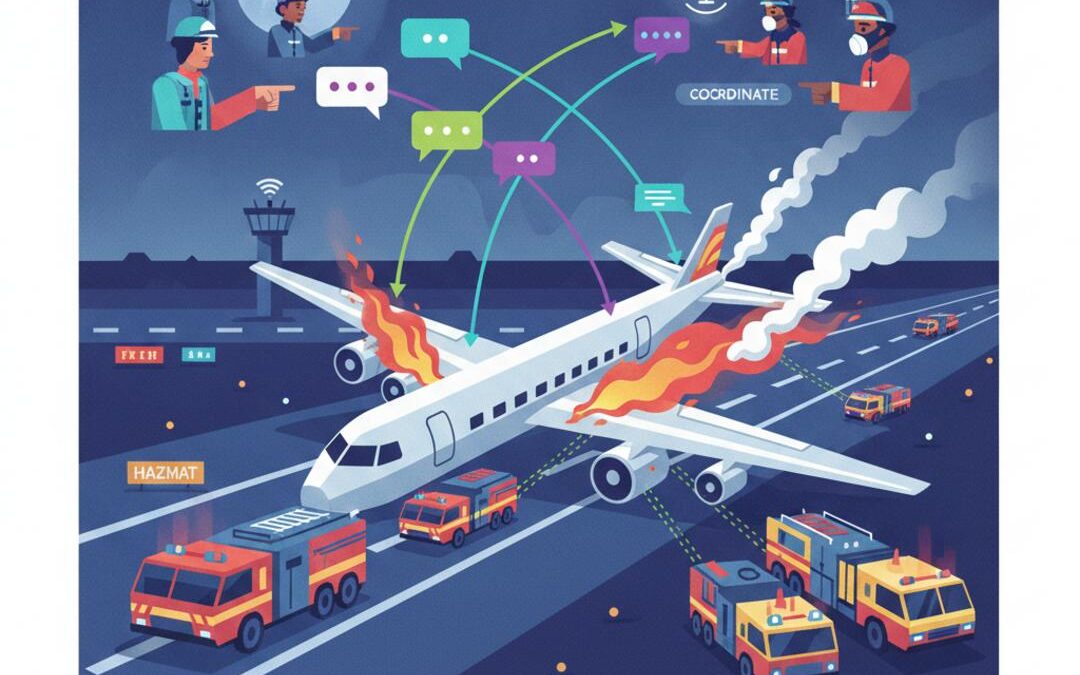
Aviation English for ARFF & Emergency Response Teams: The Mission-Critical Communication Skills Behind Every Runway Emergency in 2026
Aviation English Training
Aviation English for ARFF Staff: Why Emergency Response English Training Saves Lives in 2026
On any given day at an airport, a runway emergency can escalate from routine to catastrophic in under 60 seconds—and flawless English communication is the thin line between containment and catastrophe.
Estimated reading time: 9 minutes
Key Takeaways
- ICAO-standard phraseology is mandatory for ARFF teams, making aviation English a mission-critical competency rather than a soft skill.
- Multi-agency coordination during emergencies depends on a shared operational vocabulary that only targeted training can build.
- Stress inoculation and accent neutralization are core components of effective emergency response English training.
- 2026 brings record traffic, new aircraft technologies, and stricter regulatory audits that raise the stakes for clear communication.
- NILDS delivers scenario-based, ICAO-aligned aviation English training tailored to ARFF operational realities.
Table of Contents
- The Unique Communication Demands of ARFF and Emergency Response
- Why 2026 Raises the Stakes
- Core Skills Taught in NILDS Aviation English Training
- The NILDS Advantage: Tailored, Scenario-Based, and Compliant
- Real-World Impact: When English Saves Lives
- Conclusion: Invest in Communication, Invest in Safety
On any given day at an airport, a runway emergency can escalate from routine to catastrophic in under 60 seconds. For Airport Fire & Rescue (ARFF) and emergency response teams, technical skill is only half the battle. The other half? Flawless, unambiguous communication in English—the global language of aviation. In 2026, as air traffic rebounds and airports worldwide handle record passenger volumes, the margin for communication error is thinner than ever. This is where aviation English for ARFF staff becomes not just a nice-to-have, but a mission-critical competency.
NILDS, a leader in specialized aviation English training, understands that a firefighter’s ability to transmit a clear Mayday, coordinate a multi-vehicle response, or relay hazardous material details to incident command can mean the difference between containment and catastrophe. This article explores why emergency response English training in aviation is indispensable, and how NILDS is equipping ARFF teams with the spoken English skills they need for 2026 and beyond.
The Unique Communication Demands of ARFF and Emergency Response
Airport fire and rescue communication skills are unlike those in any other firefighting domain. ARFF teams must operate across multiple communication channels: direct radio with air traffic control (ATC), inter-team tactical channels, and face-to-face coordination with paramedics, police, and airline personnel. Each channel has its own phraseology, protocols, and stress levels.
1. Radio Discipline and ICAO Phraseology
The International Civil Aviation Organization (ICAO) mandates standardized phraseology for all aviation personnel, including emergency responders. ICAO emergency phraseology is precise: “Mayday” repeated three times, structured position reports, and standard read-backs. For non-native English speakers or teams unaccustomed to aviation-specific terminology, this can be a steep learning curve. Misheard or mispronounced words—like confusing “de-icing” with “de-escalating”—can lead to catastrophic misallocations of resources.
2. Multi-Agency Coordination
An aircraft rescue firefighting English scenario rarely involves just one team. A single incident might require coordination between ARFF, ATC, airport operations, local fire departments, and emergency medical services. English acts as the lingua franca, but only if all parties understand the same operational vocabulary. “Come out the left side” means something very specific when the aircraft is on fire.
3. Time-Critical Clarity Under Stress
Under stress, even native speakers struggle to articulate clearly. For non-native speakers, stress can cause vocabulary loss, slower speech processing, and accent thickening. Aviation safety English courses must therefore simulate high-pressure scenarios to condition responders to speak clearly, concisely, and correctly even when adrenaline is surging.
Under pressure, the difference between a clear Mayday and a misunderstood request is measured in seconds—and those seconds decide whether an emergency becomes a contained incident or a catastrophe.
Why 2026 Raises the Stakes
Several trends make aviation English for ARFF staff more urgent in 2026 than ever before:
Global Traffic Recovery. Air travel has surpassed pre-pandemic levels, with more diverse crews and passengers, making English the default for all emergency communications.
New Aircraft Technologies. Electric and hydrogen-powered aircraft introduce novel fire risks and unfamiliar vocabulary, requiring ARFF teams to learn new terms.
Regulatory Scrutiny. ICAO and national aviation authorities are auditing emergency communication competencies more rigorously, mandating documented English proficiency.
Workforce Mobility. ARFF professionals increasingly work across borders, making English the only reliable common language.
Core Skills Taught in NILDS Aviation English Training
NILDS’s program is not generic English. It is tailored to the operational realities of emergency response teams. The curriculum covers:
a) Standard and Emergency Phraseology
Trainees master ICAO-standard phrases, including distress and urgency calls, position reporting, and requests for clearance. Role-plays simulate actual radio exchanges with ATC.
b) Tactical Communication
ARFF team communication often happens on a closed tactical channel. Here, clarity is about brevity and precision. NILDS teaches standard operating procedure (SOP) language, such as “Water on, 200 gallons per minute,” or “Hazmat spill, class Bravo.”
c) Inter-Agency Liaison
Responders learn to brief incident commanders, request medical support, and coordinate with airline representatives. The focus is on active listening and closed-loop communication—confirming that messages are received and understood.
d) Stress Inoculation
Using simulated emergency scenarios, trainers introduce noise, time pressure, and information overload. Trainees must communicate effectively despite distractions, building the muscle memory for crisis communication in aviation training.
e) Accent Neutralization and Pronunciation
For non-native speakers, intelligibility is key. NILDS focuses on neutralizing heavy accents and correcting pronunciation of critical terms (e.g., “fuel” vs. “fool,” “fire” vs. “fair”).
The NILDS Advantage: Tailored, Scenario-Based, and Compliant
Unlike generic English courses, NILDS aviation English training is designed by aviation safety professionals and linguists. The program is:
Scenario-Based. Every lesson is built around real-world ARFF scenarios, from engine fires to mass casualty events.
ICAO-Aligned. Content maps directly to ICAO Language Proficiency Requirements (LPRs), ensuring compliance.
Measurable. Pre- and post-assessments track progress in comprehension, fluency, and phraseology accuracy.
Flexible. Delivered on-site or online, with modules tailored to airport size and risk profile.
For airport emergency response team training in India, NILDS has become a trusted partner, helping major airports meet DGCA and ICAO standards. But the need is global. As airports in the Middle East, Southeast Asia, and Africa expand, the demand for spoken English for aviation emergency staff has never been higher.
Real-World Impact: When English Saves Lives
Consider a 2025 incident at a busy international airport: an engine fire on a wide-body jet. The ARFF team, trained in NILDS’s program, communicated with ATC in clear, standard phraseology, requested the correct firefighting agent, and coordinated with medical teams—all in under three minutes. The fire was extinguished before it could breach the fuselage. Later, investigators praised the team’s “exemplary communication discipline.”
Contrast that with a 2023 incident where a non-native English-speaking ARFF team misunderstood a request for “foam” as “form,” delaying response by 45 seconds. No lives were lost, but the aircraft was a total write-off. The difference? English proficiency.
Conclusion: Invest in Communication, Invest in Safety
In 2026, aviation English for ARFF staff is not a soft skill—it is a hard requirement. Airports that invest in emergency response English training see faster response times, fewer errors, and stronger regulatory compliance. NILDS stands at the forefront of this niche, offering aviation safety English courses that are practical, proven, and tailored to the unique pressures of airport emergency response.
Whether you are an airport operator, ARFF chief, or training coordinator, the question is not whether your team speaks English, but whether they can communicate flawlessly when it matters most. With NILDS, you can ensure they do. Because on the runway, clarity is not just communication—it is survival.
Build the Skills for Your Global Career
Develop the communication, confidence and professional skills needed to become career-ready for aviation, hospitality and the global workplace.
Learn Today. Lead Tomorrow.
Aircraft Delivery & Ferry Flight Crews: The Aviation English Skills Powering Global Aircraft Handovers in 2026
Aviation Training
Aviation English for Ferry Flight Crews: The Key Skill for 2026
In aircraft delivery, every word matters—and English proficiency is the operational language that determines safety, speed, and success.
Estimated reading time: 9 minutes
Key Takeaways
- Aviation English is not just conversational—it is a specialized skill set covering technical documentation, ATC coordination, and commercial negotiation.
- Ferry flight crews must master four communication pillars: documentation review, acceptance test flights, cross-border coordination, and contractual discussions.
- The aircraft leasing and repossession market demands pilots who can act as inspectors, negotiators, and project managers—all in English.
- Specialized training from NILDS prepares crews for high-stakes job interviews and real-world delivery scenarios.
Table of Contents
- Introduction: The High-Stakes World of Aircraft Delivery
- Why Standard English Isn’t Enough for Ferry Flight Crews
- The Pillars of Effective Aircraft Handover Communication
- Aviation English for Aircraft Leasing and Repossession
- Preparing for the Ferry Flight Crew Job Interview
- The NILDS Advantage: Specialized Aviation English Training
- Conclusion: Communicating for Success in 2026
Introduction: The High-Stakes World of Aircraft Delivery
In the global aviation industry, an aircraft delivery is more than just a flight—it’s a complex, multi-million-dollar transaction that demands flawless coordination between manufacturers, leasing companies, airlines, and flight crews. As we move into 2026, the demand for new and repositioned aircraft continues to soar. But while the technology onboard has become increasingly sophisticated, the human element remains the critical link in the chain. Specifically, the ability to communicate clearly in English.
For ferry flight crews and delivery pilots, English is not just a nice-to-have; it is the operational language of the skies. Whether you are conducting a pre-flight acceptance test in Toulouse, coordinating a fuel stop in Reykjavik, or handling a technical discrepancy in Delhi, your proficiency in aviation English determines the success, safety, and speed of the handover. At NILDS, we understand that effective communication is the cornerstone of international aircraft delivery training. This article explores why specialized aviation English for ferry flight crews is the most valuable skill for 2026 and beyond.
Why Standard English Isn’t Enough for Ferry Flight Crews
Many pilots possess a good command of conversational English. However, ferry flight operations demand a specific subset of language skills: technical English for aircraft acceptance. This goes beyond ordering coffee or asking for directions. It involves:
- Interpreting Technical Documentation: Understanding aircraft logbooks, maintenance manuals, and airworthiness directives written in dense, technical English.
- Negotiating with Ground Crews: Clearly expressing fuel requirements, maintenance needs, and passenger handling for delivery flight coordination.
- Reporting Discrepancies: Articulating snags or issues during acceptance test flights with precision to avoid misunderstandings that could delay the delivery.
When an aircraft is being handed over, every word matters. A misinterpretation of a technical term can lead to safety risks or financial penalties. Therefore, aviation English for delivery pilots must focus on clarity, standard phraseology, and industry-specific vocabulary.
The Pillars of Effective Aircraft Handover Communication
A successful aircraft delivery relies on four key communication pillars. NILDS training programs are built around these pillars to ensure crews are prepared for any scenario.
1. Technical Documentation Mastery
Before a ferry flight even begins, crews must review a mountain of paperwork. This includes the aircraft’s delivery documents, export certificates of airworthiness, and maintenance release forms. Proficiency in aviation technical documentation English ensures that pilots can verify that the aircraft meets all contractual and regulatory requirements. In 2026, with digital documentation becoming standard, the ability to quickly parse and understand these documents on a tablet is essential.
2. Acceptance Test Flight Communication
Acceptance test flights are a critical phase where the buying party verifies the aircraft’s performance. Here, communication occurs between the delivery pilot, the manufacturer’s test pilot, and ground engineers. It involves discussing complex systems, troubleshooting anomalies, and agreeing on corrective actions. This requires a high level of spoken English for ferry pilots, including the ability to ask probing questions and understand rapid-fire technical responses.
3. Cross-Border Coordination
A ferry flight typically crosses multiple international borders, requiring interaction with various air traffic control (ATC) units, customs, and immigration authorities. While standard ICAO phraseology is used for ATC, non-standard communication with ground handlers and officials often falls outside this scope. Cross-border ferry flight operations English equips crews to handle flight planning, weather briefings, and diplomatic clearances smoothly across different cultures and accents.
4. Financial and Contractual Discussions
Often, senior ferry pilots act as the on-site representative for the leasing company or airline. They may be involved in discussions regarding delivery conditions, penalties for delays, or fuel costs. Aviation English for aircraft leasing provides the vocabulary needed to navigate these commercial conversations effectively, ensuring that the interests of the client are protected.
When an aircraft is handed over, a single misinterpreted technical term can trigger safety risks or financial penalties—precision is not optional.
Aviation English for Aircraft Leasing and Repossession
The aircraft leasing market is booming. With more aircraft being leased, sold, and transitioned between operators, the role of the ferry flight crew has expanded. They are no longer just pilots; they are inspectors, negotiators, and project managers. When an aircraft is repossessed or transitioned from one lessor to another, the crew must often work with minimal notice and in unfamiliar regulatory environments.
In these high-pressure situations, delivery flight coordination English is vital. Crews must liaise with the previous operator’s maintenance team, the new lessor’s representatives, and regulatory authorities. They need to understand the nuances of phrases like “return conditions,” “serviceable status,” and “AD compliance.” Without strong aviation English for aircraft leasing, crews risk accepting an aircraft with unresolved issues or causing costly delays during the handover process.
Preparing for the Ferry Flight Crew Job Interview
For aspiring ferry pilots, the gateway to this career is often the interview. Airlines and specialized delivery companies are looking for candidates who are not only technically proficient but also exceptional communicators. Ferry flight crew job interview English often assesses a pilot’s ability to handle hypothetical operational scenarios. Candidates may be asked to explain how they would handle a technical issue during a transatlantic crossing or how they would negotiate with a difficult ground handler.
At NILDS, our international aircraft delivery training India programs include interview preparation modules. We simulate these high-stakes conversations, helping pilots articulate their experience and problem-solving skills with confidence. This training is particularly valuable for pilots from non-native English-speaking backgrounds who need to compete in a global market.
The NILDS Advantage: Specialized Aviation English Training
At NILDS, we recognize that generic English courses do not meet the needs of aviation professionals. Our aviation English training is designed by industry experts who understand the operational realities of ferry flights and aircraft deliveries. We focus on:
Scenario-Based Learning. Practicing real-world situations like diversion planning, technical stops, and crew resource management.
Vocabulary Building. Mastering the specific lexicon of aircraft systems, leasing contracts, and regulatory compliance.
Accent Neutralization. Ensuring that pilots can be understood by ground staff and controllers worldwide, regardless of their native language.
Confidence Building. Moving beyond textbook English to fluid, assertive communication in high-pressure environments.
Our programs are tailored for delivery pilots, ferry crews, and aviation management personnel who need to communicate effectively on a global stage. By investing in aviation English for ferry flight crews, companies reduce the risk of operational errors and ensure their assets are delivered safely and efficiently.
Conclusion: Communicating for Success in 2026
As the aviation industry continues to globalize, the ability to communicate effectively in English will remain the single most important soft skill for ferry flight crews. From the technical intricacies of an acceptance test flight to the commercial negotiations of an aircraft lease, every aspect of the delivery process relies on clear, precise language.
Whether you are a pilot looking to advance your career or an operator seeking to optimize your delivery operations, investing in specialized aviation English training is not an expense—it is a strategic necessity. NILDS is committed to equipping aviation professionals with the language skills they need to power global aircraft handovers in 2026 and beyond. By mastering the language of aviation, you ensure that every handover is a success.
Build the Skills for Your Global Career
Develop the communication, confidence and professional skills needed to become career-ready for aviation, hospitality and the global workplace.
Learn Today. Lead Tomorrow.
English for Aviation Cybersecurity & Digital Operations Staff: The Communication Skills Protecting Modern Airlines from Cyber Threats in 2026
Aviation Cybersecurity
Aviation Cybersecurity English Training: The Overlooked Defense Against 2026 Cyber Threats
While firewalls and AI-driven detection tools are essential, one overlooked vulnerability remains: communication gaps among technical staff.
Estimated reading time: 8 minutes
Key Takeaways
- 70% of aviation cyber incidents involve human error, often due to unclear communication.
- English proficiency directly impacts mean time to detect (MTTD) and mean time to respond (MTTR).
- Regulations like the EU’s NIS2 Directive mandate 24-hour incident reporting, making language precision a legal requirement.
- Specialized aviation cybersecurity English training delivers 30% faster incident resolution and 50% fewer miscommunication errors.
Table of Contents
- The Unique Communication Challenges in Aviation Cybersecurity
- Why English Proficiency Directly Impacts Airline Data Security
- Key Communication Skills Every Aviation Cybersecurity Professional Needs
- How NILDS Aviation English Training Bridges the Gap
- The ROI of English Training for Aviation Cybersecurity
- Preparing for 2026 and Beyond
- Conclusion

In 2026, the aviation industry faces an unprecedented wave of cyber threats. From ransomware attacks on reservation systems to sophisticated breaches targeting air traffic control networks, airlines and aviation authorities are under constant siege. While firewalls, AI-driven detection tools, and zero-trust architectures are essential, one overlooked vulnerability remains: communication gaps among technical staff. This is where specialized aviation cybersecurity English training becomes a strategic asset.
The Unique Communication Challenges in Aviation Cybersecurity
Aviation is a global industry. A single airline might have SOC teams in Dallas, software engineers in Bangalore, and operations staff in Dubai. When a cyber incident strikes, these teams must coordinate in real time—often in English. But generic business English is not enough. Technical English for aviation IT professionals requires mastery of:
- Cybersecurity terminology (e.g., “lateral movement,” “exfiltration,” “zero-day exploit”)
- Aviation-specific systems (e.g., ACARS, ADS-B, PNR, departure control systems)
- Incident reporting protocols (e.g., ICAO Annex 17, GDPR breach notifications)
- Urgency and precision under pressure
Misunderstanding a single phrase—like confusing “containment” with “eradication”—can delay response by hours, costing millions. Studies show that 70% of aviation cyber incidents involve human error, often due to unclear communication.
Why English Proficiency Directly Impacts Airline Data Security
Consider a real-world scenario: A cybersecurity communication training aviation program is not just about grammar. It’s about ensuring that a SOC analyst in Manila can accurately describe a suspicious IP address to a network engineer in London. Or that a software engineer in Hyderabad can explain a vulnerability patch to a CISO in Atlanta.
Poor English leads to:
- Delayed incident escalation
- Inaccurate threat intelligence sharing
- Failed audits and compliance penalties
- Misconfigured security controls
Conversely, strong English for airline IT staff enables faster mean time to detect (MTTD) and mean time to respond (MTTR). In 2026, where regulations like the EU’s NIS2 Directive mandate 24-hour incident reporting, language precision is a legal requirement.
Misunderstanding a single phrase—like confusing “containment” with “eradication”—can delay response by hours, costing millions.
Key Communication Skills Every Aviation Cybersecurity Professional Needs
1. Incident Reporting in Plain and Technical English
Whether writing a post-mortem or delivering a verbal briefing, professionals must switch between technical jargon and executive summaries. Cyber incident reporting English aviation training covers templates, timestamping, and severity classification language.
2. Real-Time SOC Team Communication
In a security operations center, verbal handovers, Slack alerts, and war-room calls demand clarity. Aviation SOC team communication includes practice with phonetic alphabets (e.g., “Alpha, Bravo”), standard phrases for escalation, and active listening under stress.
3. Cross-Cultural Collaboration
Aviation cybersecurity teams are multicultural. English serves as the lingua franca. Training must address accents, idioms, and direct vs. indirect communication styles to prevent friction.
4. Technical Documentation and Email Writing
From vulnerability reports to patch notes, English for aviation software engineers ensures that documentation is unambiguous. This reduces rework and improves audit trails.
How NILDS Aviation English Training Bridges the Gap
NILDS specializes in aviation digital transformation training India and beyond, with a laser focus on cybersecurity communication. Our programs are designed by aviation IT veterans and linguists. We offer:
Scenario-based simulations. Live role-plays of ransomware attacks, data breaches, and insider threats.
Aviation-specific vocabulary banks. 500+ terms covering aircraft systems, cloud security, and regulatory frameworks.
Accent neutralization and pronunciation. For clearer radio and phone communication.
Interview preparation. Aviation IT job interview English for global roles.
Our airline data security English course has helped over 2,000 professionals from IndiGo, Emirates, and Singapore Airlines improve their communication scores by 40%.
The ROI of English Training for Aviation Cybersecurity
Investing in English for airline operations technology staff is not a soft skill luxury—it’s risk mitigation. Airlines that implement cybersecurity awareness communication aviation programs report:
- 30% faster incident resolution
- 50% reduction in miscommunication errors
- Higher employee confidence in global teams
- Improved compliance with ICAO and IATA standards
Moreover, as aviation adopts 5G, IoT, and AI, the attack surface grows. Only those who can communicate clearly will defend effectively.
Preparing for 2026 and Beyond
The cyber threats of 2026 are not just technical—they are linguistic. A phishing email with subtle grammatical errors might be ignored by a well-trained eye. But a real threat often uses perfect English. Your team must be able to dissect intent, report nuances, and collaborate seamlessly.
NILDS’ spoken English for aviation technology professionals goes beyond textbooks. We embed language into workflows: daily stand-ups, incident tickets, and threat hunts. The result is a workforce that speaks security as fluently as it speaks English.
Conclusion
As airlines digitize, the line between IT and operations blurs. English proficiency is no longer a nice-to-have—it’s a cybersecurity control. By investing in aviation cybersecurity English training, you protect not just data, but passenger trust and regulatory standing. NILDS stands ready to train your teams for the communication battles of 2026. Because in aviation cybersecurity, the right word can be the difference between a breach and a block.
Build the Skills for Your Global Career
Develop the communication, confidence and professional skills needed to become career-ready for aviation, hospitality and the global workplace.
Learn Today. Lead Tomorrow.
Aviation English for Helicopter Operations: HEMS, Offshore & Emergency Communication Skills for 2026
Aviation English
Aviation English for Helicopter Operations: The Life-Saving Skill Every Rotary-Wing Professional Needs by 2026
When English breaks down in helicopter operations, the result is not a delay — it is a risk.
Estimated reading time: 9 minutes
Key Takeaways
- Helicopter crews face more complex, multi-agency communication demands than fixed-wing pilots.
- ICAO Level 4 is a minimum — Level 5 should be the working benchmark for HEMS, offshore, and SAR roles.
- By 2026, documented English proficiency will be a hiring filter for helicopter operators worldwide.
- NILDS builds scenario-based communication skills that save lives and win contracts.
Table of Contents
- The Skies Are Changing — And So Is the Language of Rotary-Wing Aviation
- Why Aviation English Matters More in Helicopter Operations
- The Four Domains Where Helicopter English Is Tested Most
- ICAO Language Proficiency
- How NILDS Builds Life-Saving Communication Skills
- The 2026 Reality: English as a Career Filter
The Skies Are Changing — And So Is the Language of Rotary-Wing Aviation
By 2026, the global helicopter industry will face a compounding challenge: more aircraft, more complex missions, and more international crews sharing the same radio frequencies. From HEMS (Helicopter Emergency Medical Services) teams racing against the clock, to offshore crews shuttling personnel to oil rigs, to search and rescue (SAR) units coordinating in zero-visibility conditions — every second of every mission depends on one skill that is too often taken for granted: clear, standardized aviation English.
At NILDS, we have spent years training rotary-wing professionals to communicate with precision, confidence, and ICAO-compliant fluency. In this article, we break down why aviation English is no longer a “nice-to-have” for helicopter operations — it is a life-saving competency — and what every pilot, crew member, and ground operator needs to master before 2026.
Why Aviation English Matters More in Helicopter Operations Than in Fixed-Wing
Fixed-wing pilots often fly long, pre-planned routes at high altitudes, with ample time to communicate with ATC. Helicopter crews operate in an entirely different reality:
- Low-altitude, high-obstacle environments — buildings, power lines, terrain, and weather that change by the minute.
- Short, high-frequency transmissions — a HEMS pilot may relay three critical messages in under ten seconds.
- Multi-agency coordination — HEMS crews speak simultaneously with hospitals, ground ambulances, police, and ATC.
- Offshore operations — deck crews, rig control rooms, and pilots must share a common phraseology across nationalities.
When English breaks down in this environment, the result is not a delay — it is a risk. Misunderstood altitude clearances, unclear landing zone (LZ) reports, or ambiguous medical handover instructions can cost lives. This is why aviation English for helicopter pilots has become a core hiring criterion for operators in the Gulf, Europe, Southeast Asia, and India.
Aviation English is not an academic requirement. In helicopter operations, it is a survival skill — the crews who master it fly safer, coordinate faster, and get hired sooner.
The Four Domains Where Helicopter English Is Tested Most
1. HEMS and Air Ambulance Communication
HEMS crews must master a hybrid language that blends aviation phraseology with medical terminology. A typical mission involves:
- Requesting hospital helipad clearance using standard phraseology.
- Describing patient condition to receiving trauma teams.
- Coordinating with ground ambulances for patient transfer.
- Reporting weather and LZ conditions to dispatch.
Improving air ambulance communication English directly improves patient outcomes. Studies in Europe and Australia have linked communication errors in HEMS operations to delayed treatment times — a finding that should concern every EMS helicopter crew training program.
2. Offshore Helicopter Operations
Offshore flying is one of the most standardized helicopter environments in the world — and one of the most linguistically demanding. Pilots must communicate with:
- Rig and platform control rooms.
- Helideck landing officers (HLOs).
- Other helicopters in dense offshore traffic corridors.
- Coast guard and SAR assets during emergencies.
Offshore helicopter operations English requires mastery of ICAO Standard Phraseology, plus the ability to handle non-standard situations like diversions, deck emergencies, and ditching drills. For pilots working on offshore oil rig helicopter contracts, even a slight accent or vocabulary gap can cause confusion in high-stakes moments.
3. Search and Rescue (SAR) and Emergency Services
SAR missions push communication to its limits. Crews coordinate with multiple agencies, often in poor visibility and time-critical conditions. Key skills include:
- Relaying position reports under pressure.
- Describing casualty locations using grids, bearings, and landmarks.
- Coordinating winch operations with ground teams.
Strong search and rescue communication skills are not simply about vocabulary — they are about clarity under stress. That is why NILDS builds scenario-based speaking drills into every rotary-wing aviation English course.
4. Helipad and Ground Operations
Not all helicopter English happens in the air. Ground crews, HLOs, and helipad operators must communicate with pilots using precise, standard phrases. From helipad operations English to helicopter ground crew English training, the goal is the same: eliminate ambiguity. When a ground marshal says “hold” or “clear to land,” there can be no doubt about meaning.
ICAO Language Proficiency: What Rotary-Wing Professionals Must Know
ICAO requires pilots and air traffic controllers to demonstrate at least Level 4 (Operational) English proficiency, covering six skills:
Pronunciation. Clear, intelligible speech that remains understandable across accents.
Structure. Grammatical accuracy that supports clear, unambiguous transmissions.
Vocabulary. Sufficient range of technical and operational terms for the mission profile.
Fluency. Ability to speak at a natural pace without excessive hesitation.
Comprehension. Accurate understanding of both standard and non-standard transmissions, even in difficult conditions.
Level 4 is a minimum — not a target. For helicopter crews in HEMS, offshore, and SAR roles, Level 5 (Extended) should be the working benchmark, because these operations routinely involve non-routine events that demand spontaneous, accurate communication. NILDS trains crew members to not only pass the ICAO test but to operate confidently at Level 5 in real-world missions.
How NILDS Builds Life-Saving Communication Skills
NILDS takes a mission-first approach. Our NILDS aviation English training programs combine:
ICAO-aligned curriculum. Pronunciation, phraseology, and comprehension drills built around the six ICAO skill areas.
Scenario-based simulations. Live HEMS calls, offshore deck reports, and SAR coordination exercises under pressure.
Medical and technical vocabulary. Specialized terminology for EMS and offshore roles, taught in operational context.
Interview preparation. Targeted helicopter pilot job interview English coaching for international operators.
Spoken English practice. Dedicated spoken English for helicopter pilots India and global candidates.
Whether you are a HEMS captain preparing for a European operator, an offshore pilot heading to the Gulf, or a ground crew member at a busy helipad, our trainers tailor every session to your mission profile.
The 2026 Reality: English as a Career Filter
By 2026, operators in the Middle East, Europe, and Asia-Pacific will increasingly require documented English proficiency for helicopter roles. Airlines and offshore contractors are already using ICAO scores as a hiring filter. Pilots who invest in aviation English for emergency services and rotary-wing phraseology now will have a decisive career advantage — and, more importantly, they will be safer.
Final Thoughts
Aviation English is not an academic requirement. In helicopter operations, it is a survival skill. The crews who master it fly safer, coordinate faster, and get hired sooner. If you are ready to raise your communication standard to where it needs to be in 2026, NILDS is here to train you for the missions that matter most.
Mastering ICAO English Proficiency in 2026: The Ultimate Guide for Air Traffic Controllers & Flight Crews
Aviation English
Mastering ICAO English Proficiency in 2026: The Ultimate Guide for Air Traffic Controllers & Flight Crews
In the high-stakes world of aviation, clear communication isn’t just a convenience—it is a critical safety component.
Estimated reading time: 10 minutes
Key Takeaways
- ICAO mandates at least Level 4 (Operational) proficiency for pilots and controllers on international routes.
- Aviation English is a distinct subset of general English, combining standard phraseology with plain English.
- Level 5 and 6 proficiency is increasingly preferred by major carriers as the industry grows more competitive.
- Specialized training in radiotelephony and phraseology is essential for passing ICAO assessments.
- Active listening and plain English practice are the most commonly overlooked preparation areas.
Table of Contents
- Why ICAO Language Proficiency Matters More Than Ever
- Decoding the ICAO Language Proficiency Standards
- The Difference Between General English and Aviation English
- Key Components of NILDS Aviation English Training
- How to Prepare for Your ICAO Assessment
- The Role of English for Air Traffic Controllers
- Why Choose NILDS for Your Aviation English Needs?
In the high-stakes world of aviation, clear communication isn’t just a convenience—it is a critical safety component. As we approach 2026, the International Civil Aviation Organization (ICAO) continues to tighten its grip on language proficiency standards. For Air Traffic Controllers (ATCOs) and Flight Crews, mastering ICAO English proficiency is no longer just a box to tick on a resume; it is a mandatory requirement for operational legality and, more importantly, for ensuring safer skies.
Whether you are a pilot preparing for your next pilot English language test or an ATCO looking to refine your ATC communication skills, understanding the nuances of ICAO language proficiency standards is essential. In this guide, we will explore the requirements, the training strategies, and how specialized courses, such as those offered by NILDS, are shaping the future of aviation safety communication.
Why ICAO Language Proficiency Matters More Than Ever
Aviation is a global industry. A single flight might involve pilots from one continent, controllers from another, and ground staff from a third. In this multicultural environment, English has been designated as the universal language of aviation. However, standard English is not enough. The industry requires a specific dialect known as aviation English.
By 2026, the demand for high-level radiotelephony English training has surged. This is driven by:
Increased Global Traffic. With more aircraft in the sky, the margin for error in communication has shrunk.
Regulatory Updates. ICAO mandates that pilots and controllers operating on international routes must achieve at least a Level 4 (Operational) proficiency.
Safety Statistics. A significant percentage of aviation incidents are attributed to miscommunication or lack of standardized aviation phraseology.
Decoding the ICAO Language Proficiency Standards
The ICAO rating scale is divided into six levels. For licensing purposes, professionals must aim for Level 4 or higher.
The ICAO Level 4 English Benchmark
ICAO level 4 English is considered “Operational.” To achieve this, a candidate must demonstrate:
- Pronunciation: Dialect and accent do not interfere with ease of understanding.
- Structure: Basic grammatical structures and sentence patterns are used creatively and are usually well controlled.
- Vocabulary: Sufficient vocabulary to communicate effectively on common, concrete, and work-related topics.
- Fluency: Produces stretches of language at an appropriate tempo.
- Comprehension: Comprehension is mostly accurate on common, concrete, and work-related topics.
- Interactions: Responses are usually immediate, appropriate, and informative.
The Shift Toward Level 5 and 6
While Level 4 is the minimum, many airlines and authorities are now encouraging ICAO Level 5 (Extended) and Level 6 (Expert). Level 6 is valid for life, whereas Level 4 requires retesting every three years. As we move into 2026, the competitive nature of the industry means that possessing a higher proficiency level can make you a more attractive candidate for major carriers.
The Difference Between General English and Aviation English
One of the biggest mistakes professionals make is assuming that fluency in conversational English equates to proficiency in aviation English for air traffic controllers and pilots.
Aviation English is a distinct subset of the language. It includes:
- Standard Phraseology: The prescribed words and phrases used in routine situations (e.g., “Cleared for takeoff,” “Descend and maintain flight level three five zero”).
- Plain English: The spontaneous, non-standard language used during emergencies or non-routine situations. This is where ATC communication skills are truly tested.
A pilot might be able to discuss politics or order a coffee with perfect fluency, but if they cannot describe a technical malfunction using clear, concise language during a high-pressure emergency, they are a safety risk.
A pilot might be able to discuss politics or order a coffee with perfect fluency, but if they cannot describe a technical malfunction using clear, concise language during a high-pressure emergency, they are a safety risk.
Key Components of NILDS Aviation English Training
At NILDS, we understand that preparing for an aviation English assessment requires a specialized approach. Our curriculum is designed to bridge the gap between general English knowledge and the specific requirements of the cockpit and the tower.
1. Radiotelephony English Training
Our radiotelephony English training focuses on the clarity and brevity required for radio communication. We simulate real-world scenarios to help you master:
- Delivery speed and rhythm.
- Handling read-back errors.
- Managing frequency congestion.
2. Aviation Phraseology Course
We offer a comprehensive aviation phraseology course that covers both standard and non-standard procedures. This ensures that you are not only compliant with ICAO regulations but are also prepared for the unexpected.
3. English for Air Traffic Controllers India
For the Indian market, we provide tailored English for air traffic controllers India modules. We address the specific linguistic challenges faced by Indian speakers and help them neutralize accents that might impede international comprehension.
How to Prepare for Your ICAO Assessment
Preparing for the pilot and controller communication English assessment requires a strategic approach. Here are expert tips to help you succeed:
Immerse Yourself in the Language
Surround yourself with aviation English. Listen to LiveATC.net to hear how real-world flight crew English proficiency is demonstrated. Pay attention to how controllers handle complex situations.
Practice Plain English
While phraseology is crucial, don’t neglect plain English. Practice describing visual images, technical issues, and weather phenomena without using jargon. This is a common stumbling block in the ICAO English proficiency test.
Focus on Active Listening
The most common cause of communication failure is not speaking poorly, but listening poorly. In a noisy environment, you must be able to extract critical information from a garbled transmission.
The Role of English for Air Traffic Controllers
Air traffic controllers are the conductors of the skies. Their ATC communication skills must be flawless. A controller must process information rapidly and relay instructions clearly. Effective aviation safety communication involves:
Anticipation. Understanding what the pilot is likely to say next.
Clarity. Using standard pronunciation.
Error Correction. Politely but firmly correcting a pilot’s read-back error immediately.
Why Choose NILDS for Your Aviation English Needs?
NILDS is at the forefront of NILDS aviation English training. We combine linguistic expertise with deep aviation knowledge to deliver a training experience that is both relevant and rigorous.
Our programs are designed to:
Diagnose. We identify your specific weaknesses through mock aviation English assessment tests.