
Aviation English
Aviation English for In-Flight Retail: How Cabin Crew Can Sell More in English
In 2026, airlines are running high-altitude retail operations where every interaction is a revenue opportunity — and English is the skill that turns service into sales.
Estimated reading time: 8 minutes
Key Takeaways
- Ancillary revenue will exceed $130 billion by 2026, with onboard sales a major slice.
- Most cabin crew are trained in hospitality English, not sales English — and it’s costing airlines millions.
- Aviation English for in-flight retail combines product vocabulary, persuasive phrasing, and objection handling.
- NILDS builds revenue-ready cabin crew through role-play, pitch labs, and clarity coaching.
- English is no longer a basic requirement — it is a revenue skill that pays for itself on the first flight.
Table of Contents
In 2026, airlines are no longer just flying people from A to B. They are running high-altitude retail operations where every interaction is a revenue opportunity. From duty-free trolleys to onboard meal upgrades and credit card promotions, cabin crew are now front-line salespeople. But here is the catch: most crew members are not trained to sell in English. They can serve, they can smile, they can handle safety—but when it comes to recommending a premium whiskey, upgrading a passenger to a better seat, or explaining a loyalty program, many freeze. That is where aviation English for in-flight retail becomes a game-changer.
Why In-Flight Retail Is a Goldmine (And Why English Matters)
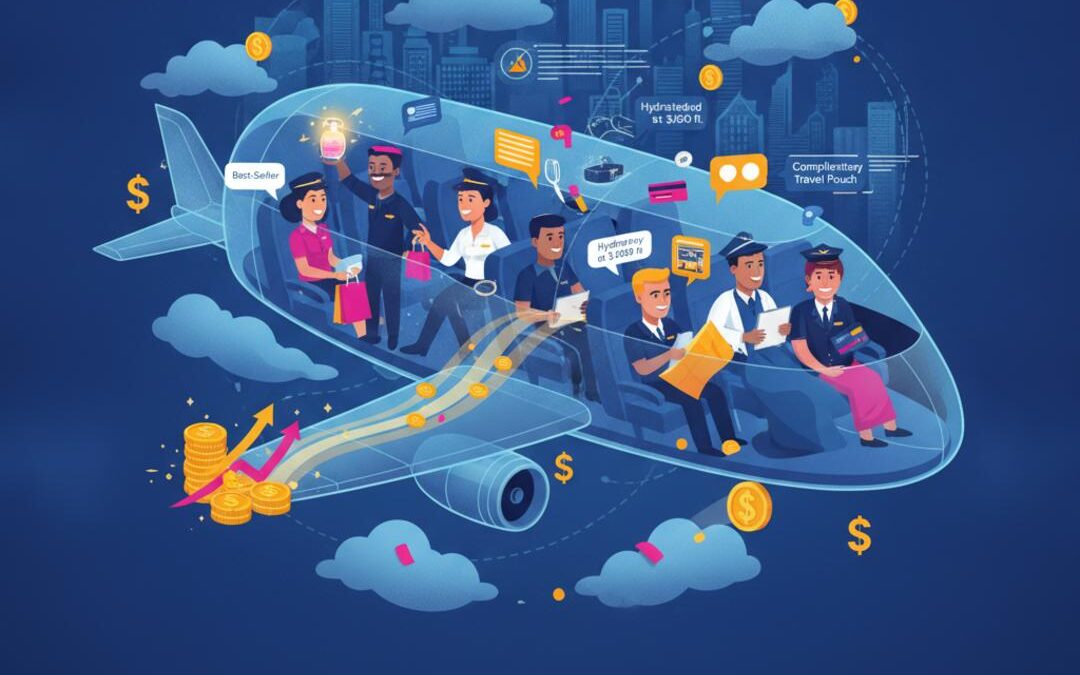
Ancillary revenue now accounts for a significant share of airline profits. According to industry estimates, global ancillary revenue will exceed $130 billion by 2026. Onboard sales—duty-free, food and beverage upgrades, comfort items, and travel accessories—are a major slice of that pie. But here is the problem: on international routes, passengers speak dozens of languages. English remains the common denominator. When a crew member can confidently say, “This fragrance is our best-seller, and today it comes with a complimentary travel pouch,” the likelihood of a sale skyrockets.
Airlines that invest in in-flight sales English training see measurable results: higher conversion rates, larger average transaction values, and improved customer satisfaction. Why? Because selling in English is not about pushy tactics. It is about clarity, warmth, and the ability to match a product to a passenger’s need—all in a second language.
The Hidden Barrier: Crews Know Service, Not Sales English
Most cabin crew are trained in hospitality English for cabin crew: greetings, safety instructions, meal service, and handling complaints. That is essential. But upselling requires a different vocabulary. You need phrases for product recommendation, handling objections, creating urgency, and closing a sale. Without dedicated cabin crew upselling English, crew members often default to passive service: “Would you like to buy something?” instead of “I highly recommend this for your flight—it is our most popular item today.”
This gap is costing airlines millions. A crew that cannot confidently explain a product’s value in English will not sell it. A crew that cannot handle a simple question like “Is this compatible with my phone?” will lose the sale. And a crew that sounds unsure or scripted will not build the trust needed for onboard retail communication English to work.
The real problem is not the product or the price — it is that crew members have never been taught how to sell in English.
What Is Aviation English for In-Flight Retail?
Aviation English for in-flight retail is a specialized branch of English training that combines general aviation English with sales and hospitality communication. It focuses on:
Product vocabulary. Describing fragrances, electronics, accessories, and duty-free exclusives with confidence.
Persuasive phrasing. “This is perfect for”, “You will love how”, “Many passengers choose this because”.
Handling questions. Answering about prices, currencies, warranties, and compatibility clearly and quickly.
Upselling and cross-selling. “Would you like to add a second one at a discount?” or “This pairs beautifully with the item you just selected.”
Cultural sensitivity. Adjusting tone for different passenger nationalities while keeping English as the base.
At NILDS, our aviation English training 2026 programs are built specifically for airline ancillary revenue teams. We do not teach generic business English. We teach the exact phrases, scenarios, and confidence builders that turn a service interaction into a sale.
Duty-Free Selling Phrases That Actually Work
Let us get practical. Here are five English phrases that cabin crew can use immediately to boost onboard sales:
The Warm Open. “While you are relaxing, may I show you something special we have on board today?”
The Benefit Hook. “This moisturizer is perfect for long-haul flights—it keeps your skin hydrated at 35,000 feet.”
The Social Proof. “This is our best-selling perfume this month. Would you like to try a sample?”
The Gentle Close. “Shall I wrap this up for you, or would you like to see one more option?”
The Upsell. “If you take two, you get a free travel case—many passengers do this for gifts.”
These are not manipulative tricks. They are clear, polite, and effective. But they require practice. Crew members need to say them until they feel natural, not memorized. That is why spoken English for cabin crew upselling must be interactive, scenario-based, and repetitive in a safe training environment.
How NILDS Builds Revenue-Ready Cabin Crew
NILDS specializes in aviation English training for airlines that want to turn language skills into profit. Our programs include:
Role-play simulations. Real in-flight scenarios with passengers from different cultures.
Product pitch labs. Crew members practice describing actual duty-free items in English.
Objection handling drills. “That is too expensive” or “I will think about it”—and how to respond.
Accent and clarity coaching. So every passenger understands the first time.
Ancillary revenue communication skills. Linking sales to service, not pressure.
We have worked with airlines across Asia, the Middle East, and Europe. The common thread? Crews who feel confident in English sell more, smile more, and create a better passenger experience. That is the definition of a win-win.
The 2026 Advantage: English as a Revenue Skill
By 2026, competition in the skies will be fiercer than ever. Low-cost carriers are expanding, premium airlines are differentiating through service, and every route is a battle for ancillary revenue. Airlines that treat English as a basic requirement will fall behind. Airlines that treat English as a revenue skill—specifically, in-flight sales English training—will lead.
Your crew does not need to become fluent salespeople. They need to become confident English communicators who can recommend, explain, and close. That is a learnable skill. And it pays for itself on the very first flight.
Final Thought: Speak Better, Sell More, Fly Further
If you are an airline training manager, a cabin crew recruiter, or a crew member who wants to earn more through onboard sales, the message is simple: invest in English for airline ancillary revenue teams. It is not an expense. It is a revenue accelerator.
At NILDS, we help aviation teams unlock that potential. Because when your crew speaks better, they sell better. And when they sell better