
Aviation English Training
Aviation English for ARFF Staff: Why Emergency Response English Training Saves Lives in 2026
On any given day at an airport, a runway emergency can escalate from routine to catastrophic in under 60 seconds—and flawless English communication is the thin line between containment and catastrophe.
Estimated reading time: 9 minutes
Key Takeaways
- ICAO-standard phraseology is mandatory for ARFF teams, making aviation English a mission-critical competency rather than a soft skill.
- Multi-agency coordination during emergencies depends on a shared operational vocabulary that only targeted training can build.
- Stress inoculation and accent neutralization are core components of effective emergency response English training.
- 2026 brings record traffic, new aircraft technologies, and stricter regulatory audits that raise the stakes for clear communication.
- NILDS delivers scenario-based, ICAO-aligned aviation English training tailored to ARFF operational realities.
Table of Contents
- The Unique Communication Demands of ARFF and Emergency Response
- Why 2026 Raises the Stakes
- Core Skills Taught in NILDS Aviation English Training
- The NILDS Advantage: Tailored, Scenario-Based, and Compliant
- Real-World Impact: When English Saves Lives
- Conclusion: Invest in Communication, Invest in Safety
On any given day at an airport, a runway emergency can escalate from routine to catastrophic in under 60 seconds. For Airport Fire & Rescue (ARFF) and emergency response teams, technical skill is only half the battle. The other half? Flawless, unambiguous communication in English—the global language of aviation. In 2026, as air traffic rebounds and airports worldwide handle record passenger volumes, the margin for communication error is thinner than ever. This is where aviation English for ARFF staff becomes not just a nice-to-have, but a mission-critical competency.
NILDS, a leader in specialized aviation English training, understands that a firefighter’s ability to transmit a clear Mayday, coordinate a multi-vehicle response, or relay hazardous material details to incident command can mean the difference between containment and catastrophe. This article explores why emergency response English training in aviation is indispensable, and how NILDS is equipping ARFF teams with the spoken English skills they need for 2026 and beyond.
The Unique Communication Demands of ARFF and Emergency Response
Airport fire and rescue communication skills are unlike those in any other firefighting domain. ARFF teams must operate across multiple communication channels: direct radio with air traffic control (ATC), inter-team tactical channels, and face-to-face coordination with paramedics, police, and airline personnel. Each channel has its own phraseology, protocols, and stress levels.
1. Radio Discipline and ICAO Phraseology
The International Civil Aviation Organization (ICAO) mandates standardized phraseology for all aviation personnel, including emergency responders. ICAO emergency phraseology is precise: “Mayday” repeated three times, structured position reports, and standard read-backs. For non-native English speakers or teams unaccustomed to aviation-specific terminology, this can be a steep learning curve. Misheard or mispronounced words—like confusing “de-icing” with “de-escalating”—can lead to catastrophic misallocations of resources.
2. Multi-Agency Coordination
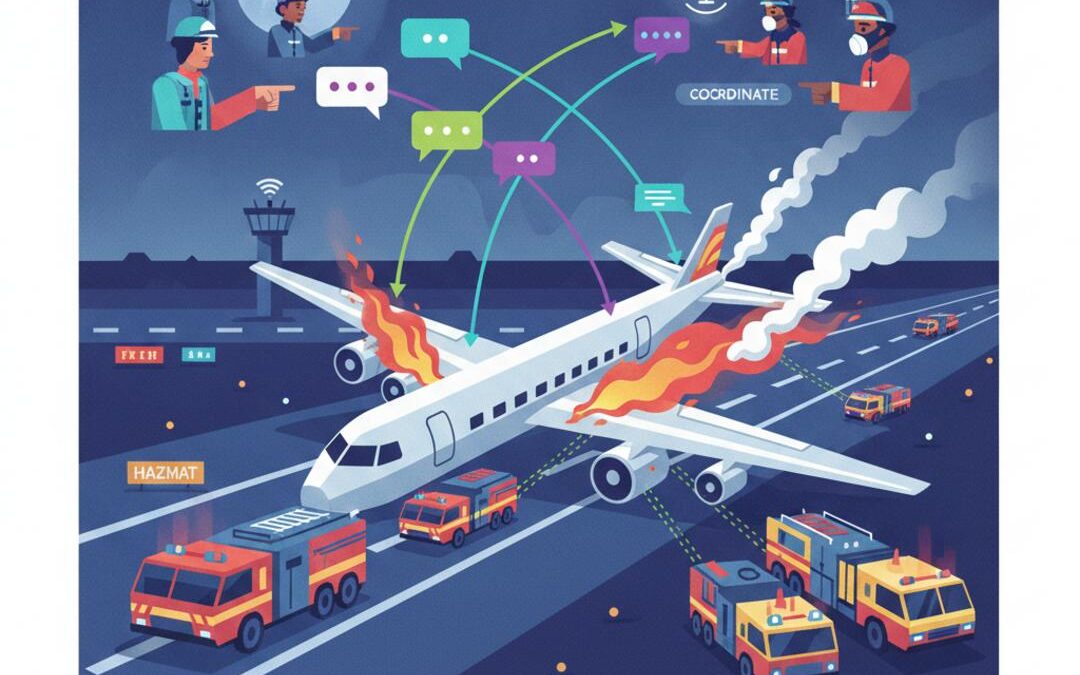
An aircraft rescue firefighting English scenario rarely involves just one team. A single incident might require coordination between ARFF, ATC, airport operations, local fire departments, and emergency medical services. English acts as the lingua franca, but only if all parties understand the same operational vocabulary. “Come out the left side” means something very specific when the aircraft is on fire.
3. Time-Critical Clarity Under Stress
Under stress, even native speakers struggle to articulate clearly. For non-native speakers, stress can cause vocabulary loss, slower speech processing, and accent thickening. Aviation safety English courses must therefore simulate high-pressure scenarios to condition responders to speak clearly, concisely, and correctly even when adrenaline is surging.
Under pressure, the difference between a clear Mayday and a misunderstood request is measured in seconds—and those seconds decide whether an emergency becomes a contained incident or a catastrophe.
Why 2026 Raises the Stakes
Several trends make aviation English for ARFF staff more urgent in 2026 than ever before:
Global Traffic Recovery. Air travel has surpassed pre-pandemic levels, with more diverse crews and passengers, making English the default for all emergency communications.
New Aircraft Technologies. Electric and hydrogen-powered aircraft introduce novel fire risks and unfamiliar vocabulary, requiring ARFF teams to learn new terms.
Regulatory Scrutiny. ICAO and national aviation authorities are auditing emergency communication competencies more rigorously, mandating documented English proficiency.
Workforce Mobility. ARFF professionals increasingly work across borders, making English the only reliable common language.
Core Skills Taught in NILDS Aviation English Training
NILDS’s program is not generic English. It is tailored to the operational realities of emergency response teams. The curriculum covers:
a) Standard and Emergency Phraseology
Trainees master ICAO-standard phrases, including distress and urgency calls, position reporting, and requests for clearance. Role-plays simulate actual radio exchanges with ATC.
b) Tactical Communication
ARFF team communication often happens on a closed tactical channel. Here, clarity is about brevity and precision. NILDS teaches standard operating procedure (SOP) language, such as “Water on, 200 gallons per minute,” or “Hazmat spill, class Bravo.”
c) Inter-Agency Liaison
Responders learn to brief incident commanders, request medical support, and coordinate with airline representatives. The focus is on active listening and closed-loop communication—confirming that messages are received and understood.
d) Stress Inoculation
Using simulated emergency scenarios, trainers introduce noise, time pressure, and information overload. Trainees must communicate effectively despite distractions, building the muscle memory for crisis communication in aviation training.
e) Accent Neutralization and Pronunciation
For non-native speakers, intelligibility is key. NILDS focuses on neutralizing heavy accents and correcting pronunciation of critical terms (e.g., “fuel” vs. “fool,” “fire” vs. “fair”).
The NILDS Advantage: Tailored, Scenario-Based, and Compliant
Unlike generic English courses, NILDS aviation English training is designed by aviation safety professionals and linguists. The program is:
Scenario-Based. Every lesson is built around real-world ARFF scenarios, from engine fires to mass casualty events.
ICAO-Aligned. Content maps directly to ICAO Language Proficiency Requirements (LPRs), ensuring compliance.
Measurable. Pre- and post-assessments track progress in comprehension, fluency, and phraseology accuracy.
Flexible. Delivered on-site or online, with modules tailored to airport size and risk profile.
For airport emergency response team training in India, NILDS has become a trusted partner, helping major airports meet DGCA and ICAO standards. But the need is global. As airports in the Middle East, Southeast Asia, and Africa expand, the demand for spoken English for aviation emergency staff has never been higher.
Real-World Impact: When English Saves Lives
Consider a 2025 incident at a busy international airport: an engine fire on a wide-body jet. The ARFF team, trained in NILDS’s program, communicated with ATC in clear, standard phraseology, requested the correct firefighting agent, and coordinated with medical teams—all in under three minutes. The fire was extinguished before it could breach the fuselage. Later, investigators praised the team’s “exemplary communication discipline.”
Contrast that with a 2023 incident where a non-native English-speaking ARFF team misunderstood a request for “foam” as “form,” delaying response by 45 seconds. No lives were lost, but the aircraft was a total write-off. The difference? English proficiency.
Conclusion: Invest in Communication, Invest in Safety
In 2026, aviation English for ARFF staff is not a soft skill—it is a hard requirement. Airports that invest in emergency response English training see faster response times, fewer errors, and stronger regulatory compliance. NILDS stands at the forefront of this niche, offering aviation safety English courses that are practical, proven, and tailored to the unique pressures of airport emergency response.
Whether you are an airport operator, ARFF chief, or training coordinator, the question is not whether your team speaks English, but whether they can communicate flawlessly when it matters most. With NILDS, you can ensure they do. Because on the runway, clarity is not just communication—it is survival.
Build the Skills for Your Global Career
Develop the communication, confidence and professional skills needed to become career-ready for aviation, hospitality and the global workplace.
Learn Today. Lead Tomorrow.